

The Japanese manga publisher, Shonen Jump, has been the largest puller of manga fans throughout the world. As of recent, one can count Shuiesha’s Shonen Jump as a competitor to Marvel Comics and DC Comics (for reasons we’ll get to later). With such a monster of a company, they surely have produced great manga series throughout the ages. And in each era, people have had a new reason to love their products.
The late 1980’s, a period of economic losses throughout the world, is the time period I would designate as the Classic Era of Shonen Jump. Classic to us now because back then they had Saint Seiya, Fist of the North Star, Phantom Blood, Dragon Ball, Slam Dunk and Yu Yu Hakusho just to name a few. This era had quite a few big sellers as you may know and they all featured original personas people now call the serious badass ‘Kenshiro’ archetype or the simpleton fighter ‘Goku’ archetype.
The 90’s held a brief interregnum as the only growing series were things like Rurouni Kenshin and Yu-Gi-Oh. Not super big but still good enough. That was until the turn of the century where the Golden Age began. One Piece, Hunter x Hunter, Naruto, Bleach, Gintama and many other big names that would go on to define Shonen. With the anime adaption of Dragon Ball reaching the West and the growth of the Internet, these products continued to grow in popularity and sell millions.
Many of these series were successful enough to gain instant anime adaptions (Hunter x Hunter for example). And each other them tried their best to keep readers turn to the next page because of the way Shonen Jump works. You see, in Japan, SJ publishes their manga in magazines where at the end of each, the readers are able to vote on the best chapter that week. The better series would gain front page privileges while underrated series were pushed back and even canceled. I said that last part like it was rare to be cancelled but in actuality, it’s hard for many mangaka to make a sequel to their one-shots at Shonen Jump. They are looking to make the most money.
So they wanted to find the next Dragon Ball, JoJo’s, or at least a copy of Togashi. This means finding a series with the most potential, at least if the readers received it well, that can last long and bring in lots of cash from the manga and anime run. And if they find this series, it must be extended. It must not end quickly. It will be advertised to everyone and their mother. For the west, the series must be synonymous to anime, Japan, or peak fiction.

Here comes Tite Kubo with Bleach. Bleach, inspired by Saint Seiya and the idea of Shimigami wearing kimonos, was a break out series that started in 2001. With an anime in 2004, it would be decently received in Japan and very well received in the United States. A synopsis; it’s about a bright haired Japanese boy taking the powers of a Shinigami thus taking on the responsibilities of one. Yes, Ichigo has Marvel type origins. Shinigami are the gods of death in Japanese lore although they are usually not depicted in the black kimonos Kubo came up with. They also aren’t proficient swordsmen but just take care of souls who’ve died. For Ichigo, since he has powerful spiritual energy, bad spirits are actually attached to his hometown which he now has the power to protect. Overtime though, with Kubo getting promotions from SJ, the series fell into a twice repeated rescue plotline along with giving Ichigo enough bloodlines to start his own superrace. Now all the big series in the Golden Era are attacked for being somewhat derivative although Kubo was already inspired by Saint Seiya’s character designs and writing. One could also point out the similarity between Bleach’s opening arc and Yu Yu Hakusho’s (the only difference being that Yusuke is dead). Rude guy sacrifices himself and now has ghost powers along with a female partner in order to defeat other more unruly ghosts? It does have its own flare of using Spanish terms and lots of poetry. In my personal experience, Bleach was always present. Not like super popular but if you know about anime, you knew about Bleach. I even watched the first season but nothing further than the Conquistadors vs Ichigo fight. I’ll try to restart sometime soon…
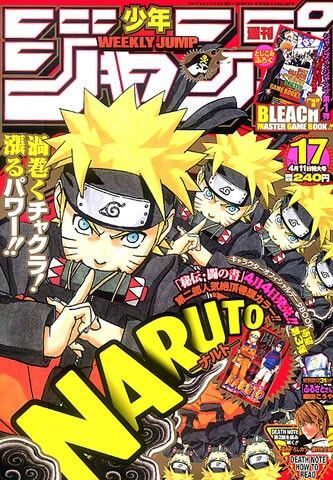
Next up is Naruto by Masashi Kishimoto, a series about the titular character becoming the top ninja (or shinobi) of his respective village. Starting in 1999 with an anime by 2002, the series would grow to be very popular in both Japan and the United States. Hell even before I was into anime, Naruto was something I was well aware of. Now Naruto’s journey is not a simple one. While he aspires for greatness, he’s brought down by three main anchors. First, a personal weakness as he doesn’t really know how to concentrate chakra at first, something most of his peers can do with high professionalism. Secondly, he is possessed by a demon fox that killed his parents (he does not knows this) and has a tendency to override his consciousness when in a state of danger. Lastly, the society of ninja is one that uses them as tools of a nation’s whims rather than the good of mankind. While he doesn’t have a moral struggle for this (initially), it makes the Hokage role something for the reader to consider.
With these conflicts for Naruto, along with an iconic rival by the name of Sasuke, the series would skyrocket in popularity. It was especially well received in the west, almost like a successor to Dragon Ball. Like, you know how most of everyone is somewhat familiar with the Kamehameha despite not everyone watching the show? In middle school, (2013ish for me) kids were already familiar with the so called Naruto run. It’s main contemporary, One Piece by Oda, also shared a sibling like rivalry with the series. It was basically between the two of them on who was on SJ’s cover. And let’s not forget the impact Sasuke had on the definition of ‘edgelord’. Without, him or Shadow the Hedgehog, that word may have a less funny story behind it. And comparing it to Bleach, that was praised for it’s grace. Because it looked prettier, because Ichigo didn’t copy Goku’s mannerisms like Naruto did, and because it was more popular; it did not have to regarded as a Dragon Ball knock off. Naruto did along with claims of copying Togashi, someone Kishimoto regarded as an inspiration. In the end, Naruto became definitionally ‘basic Shonen’ or even just as an anime starter if you are uncultured. (Cultured animes being Fullmetal, Fairy Take, or Bleach). With it’s ups and downs during the later arcs, Naruto finished with enough prestige to be promised a sequel.
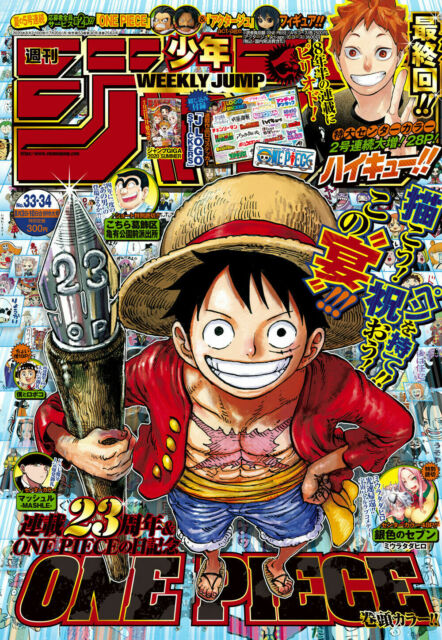
Last but definitely not least would be One Piece by Eichiro Oda, also known as Goda or Frauda, a series that is still ongoing since 1997. So yes, as most know or assume, the series has 1041 chapters (as of writing). Here again we have Luffy wishing to be the king of pirates or basically the best person in his field. Just as Naruto is stuck in a world of ninja, Luffy is also stuck in a world of sailors, be them lawfully ambiguous marines or freedom loving pirates. He also adopted some Goku mannerism but with his family name being Monkey, dark hair, and a more belligerent attitude; there’s a better argument that he is Goku inspired than Naruto. Unlike Naruto, he is not that weak at first. In fact, he was arguably the strongest pirate in his quarter of the world and has only gotten stronger. On his journey he also coerced- no I mean recruited ten weirdos to his crew. And I mean weirdos. One dude is a literal wandering swordsmen (do to his lack of direction) with a demon motif, then we have a thief that can control the weather, a sniper that can manifest a fear for anything, a love struck chef that can ignite himself, a reindeer that can become man, and an archeology nerd who’s existence is illegal. And then we get to the simple ones like cyborg, skeletons and Aquaman.
Now how do we measure the worth of a manga outside of SJ’s magazine ranking. Well, after a manga has had ten chapters (or around that) they can be easily packaged into one volume involving those chapters. These are separate from the influence of other mangas and always have their own covers. This is how physical manga will arrive in the West. Americans never get to see the magazines. Now Marvel and DC comics are sold in single issue little pamphlets that discuss only one episode of one story line. So there is a difference in publishing and there would be a difference in price. Nonetheless, Marvel’s champion lies in its 59 year old Spider-Man comics that include 13,000 issues and 397 million sales. DC’s champion lies in the 83 year old Superman comics that hold 15,000 issues and 600 million sales. Then come’s Shonen Jump’s champion; the 25 year old One Piece that holds 101 volumes (and about 1044 chapters) and about 500 million sales. That would make One Piece the most successful manga and since it’s still ongoing, it has a chance to beat Superman.
(These numbers are approximations and maybe inaccurate in a few weeks time.)
So during their reign, Bleach, Naruto, and One Piece enjoyed their position as the Big 3 Shonen Jump manga’s. Everyone knew about them and to get into manga (if you were in the west) you had to have at least knew about them. But with the death of Bleach and Naruto, people have been searching for new things. Some people want to discover a new Big 3. Others were inspired by the wide array of Japanese fiction and decide to discredit mainstream content altogether. Hatred for the previous Big 3 sprouted from these folks. But especially Shonen Jump was looking for another big seller to ride under One Piece’s wings (until that would finish). It isn’t that the series needs to be popular but have the potential to last long.
So there have been a few series that they propped up since 2016. My Hero Academia, Black Clover, JuJutsu Kaisen, and Demon Slayer just to name a few. And over the last few years, these names have also popped up in discussions over a new Big 3. And yet there is still a disagreement in even having the discussion. Some fans feel like the Big 3 will never be surpassed, at least not while they are still in recent memory. And because these new series are (not my opinion) so derivative of the Big 3, but also fail at delivering the same entertainment, that they cannot truly replace them. They would just be knockoffs. There are others though that argue the Big 3 need not be replaced and that the title is just given to any of the biggest manga in a certain era. They do not need to out sale their predecessors but simply sell at all. There are still others, like early My Hero Academia fans for example, who found their series when it was not mainstream. And they feel so unique in liking it that they don’t want to ever consider it mainstream because then it would be just as bad as the previous series that they hated due purely to popularity. Their opponents are those who did meet My Hero Academia when it was small and have been long awaiting to place it at #2, right underneath One Piece. Mind you, Big 3 should never be a measure of how good the series is cause Bleach and Black Clover is some dogshit fr fr.
Here’s the thing. I am of the argument that all the Big 3 need to do is sell. Now One Piece is still running and those 4 new series I mentioned are like 75% done. Demon Slayer ended only after 200 chapters and that was only due to the Editor extending the finale of the series. To the point that the mangaka’s epilogue was one quick chapter to satisfy themselves while I imagine it could have been 10 chapters long. My Hero Academia started it’s final arc at chapter 300, so I am only expecting it to get to 400 although the pacing seems to desire less. JuJutsu Kaisen just past 100 chapters and is only in its third major arc so I expect it to last a bit longer. Lastly, Black Clover is just over 300 chapters and I am unsure if its not too soon to start packing our bags there.
In my opinion, if One Piece were to rest at #1, then #2 and #3 would be My Hero Academia and Demon Slayer respectively. #4 would then have to be Black Clover as JuJutsu Kaisen is a bit too new. Well I should do a quick synopsis on them!
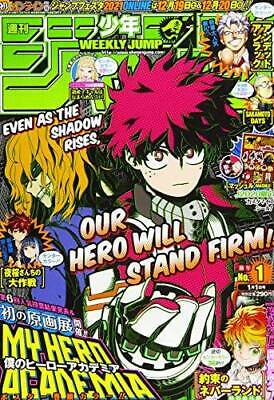
My Hero Academia is a social media age manga written by Kohei Horikoshi. It started in 2014, just before the end of Naruto which is why I pointed out that it is a social media age manga. 2014 was around the time certain sites like Tumblr, Reddit, Twitter, and Facebook had finished consolidating necessity from the average citizen. So the series would pop off especially because of the Tumblr fandoms. But the series begins with this young boy admitting to the fact that humans are not born equal. I agree but his excuse is that he was born into a world quirkless despite most of everyone else having a quirk. Quirk’s are just superpowers in this story. Unlike other series though, these are genetic, come in three classifications, and have created a world of superheroes and supervillains. Izuku Midoriya grows up getting bullied by fellow classmate Katsuki Bakugo and wishing to act like the heroic All Might. But “Deku” is in luck when he comes across All Might who, at a later moment, decides to make the kid his apprentice. Because of that, Deku is able to attend All Might’s old high school, a special school that raises heroes, and is able to actively become the world’s greatest hero.
Horikoshi has admitted the series to be inspired by the American comics which only feature superheroes. Never pirates or ninja. Only pirate heroes and ninja heroes. I would also like to point the film Sky High being a possible, although on the slimmest of chances, tiny inspiration for the school. And yes, just for the meme “Sky High walked so My Hero could run”. Anyways the series does feel very American inspired and it’s nice to see something in the modern era with regular technology. It’s not actually too clear but I’m assuming the series takes place in the future and yet the characters still only just got iPhones. They still have regular vehicles and the nations displayed are not in a weirder state than ours. Also, Deku narrates the series (due to being a superhero nerd) and already spoiled the end at the first chapter; but his narration provides a nice insight that mangas don’t always do. It’s popularity is also nothing to scoff at. MHA shirts are just as frequented as Dragon Ball shirts, just for a different demographic. It’s defiantly a millenial-zoomer series and the humor fits in with Internet memes and juvenile slang. I would say, in the same way Bleach characters had intense drip, Horikoshi goes insane in character designs. Even the overly sexualized girls look American Protestant safe enough that one would watch the show around their parents. And besides that, everyone looks cool. Even the ugly characters look like the cool type of ugly. Danny Devito style.
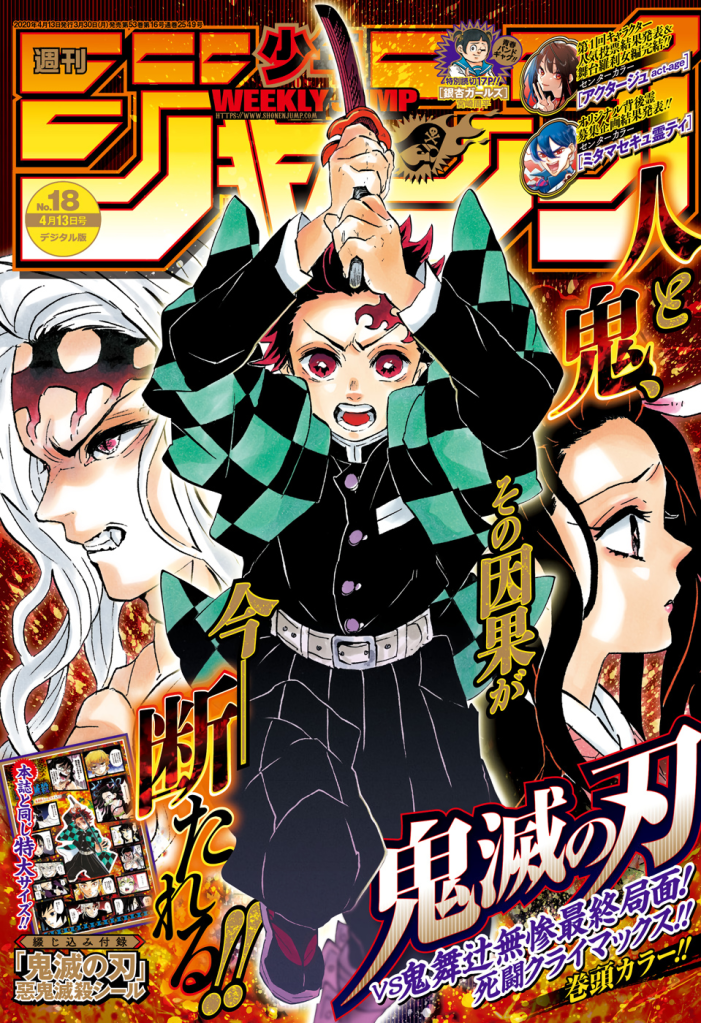
Next is Demon Slayer by Koyoharu Gotouge who is kept unknown to the public. Gotouge had written a few one shots before but was advised to start a simple series which became Demon Slayer. In this story, young Tanjiro Komodo returns to his house finding his family murdered by a demon although his sister survived only by being turned a demon. In his great sorrow, he decided he would find a cure for his sister, Nezuko, and for that he would have to join the Demon Slayer Corps. This is a group of basically samurai who hard train themselves specifically in the execution of the spawn of demon daddy Muzan Kitbutsuji.
What makes Tanjiro unique among all other protagonist (that I know of at least) is that he truly does not care for his enemy. He’s here to kill them, they need to be murdered, and he will always watch them die. No but seriously, this is morally alright in the series as the demons Muzan creates are not just bad spirits but regular people he injected his blood into; gifting them immortality (unless in the sun) and a lust for humans thus making them tortured souls stuck on Earth. So killing them is a mercy, one that Tanjiro is glad in doing especially since killing a certain few of them will bring him closer to curing his sister. He’s like if Blade was Japanese. Actually, in fact none of the Demon Slayers have any remorse for the demons. In any other series, there’s always at least one bad guy that either the audience or the characters justify in letting live but not here. Each of them have horrible memories and Muzan is a stain on humanity regardless. Not one demon gets a bittersweet death and to be honest, none deserve it. This is still my attitude even after reading every flashback Gotouge gives to us of the demons in their past life. And that’s how a demon should be treated. Now Gotouge has called Araki, Naruto, Bleach, and Gin Tama as inspirations. The s killing samurai lost souls is defiantly a Bleach take away. Two big themes throughout the series are family and fate and those two actually come intertwined in a reincarnation by the series end. Now, throughout its first 2 years, it was pretty standard; but when Ufotable adapted the series into an anime, the popularity skyrocketed. At the same time, One Piece was going through it’s Whole Cake Island and Wano arcs which was some of the most hyped storylines thus far. And Demon Slayer was still outselling it on a quarterly basis. Only 23 volumes but a reported 150 million copies sold. I want to give it credit of it’s popularity due to it’s influence on common fashion. In the series, each Demon Slayer has a kimono of a specific pattern with each one just as if not more pretty than the last. Tanjiro’s is a checkerboard green and black kimono that I would consider iconic. This is simply due to working in a tourist location where people have this pattern on headbands, scarfs, backpacks, tattoos, phone cases, and even their own kimonos. I simply point to them and say, “Tanjiro” and they get all excited to talk about Demon Slayer. It’s like the webs of Spider-Man’s suit; simplistic but socially copyrighted by the original character.
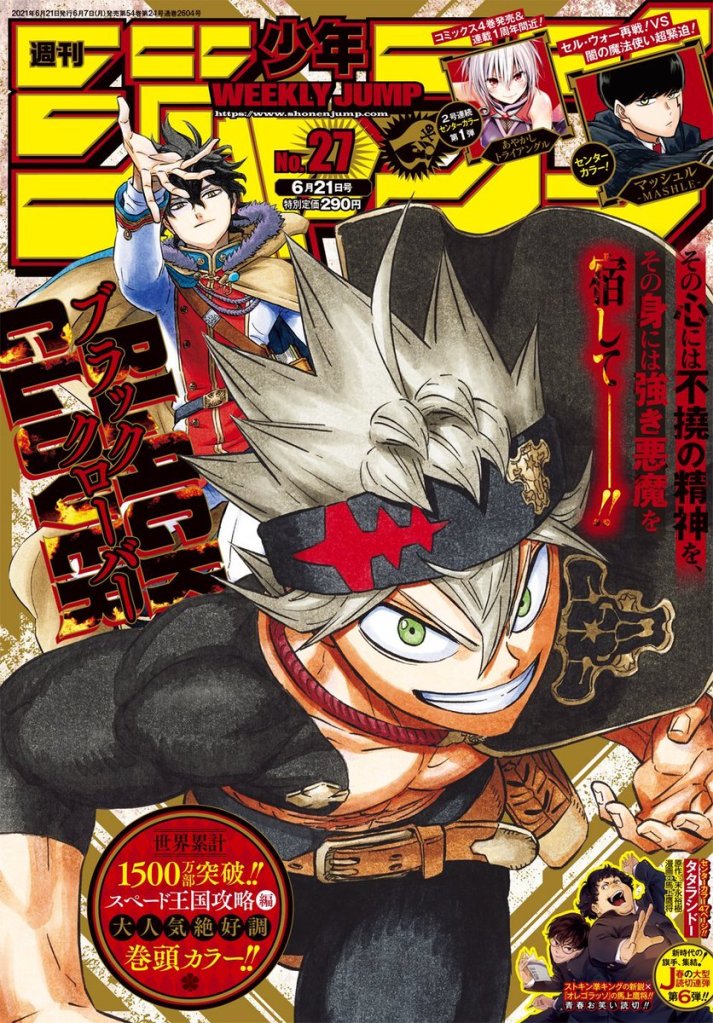
Black Clover is the last one and the one series I know the least about. I have only read 50-ish chapters so far of Yuki Tabata’s work. The series stars the jock orphan Asta who aspires to be the wizard king in a world full of magicians but he has, guess what, no magical attributes. Magic exists everywhere and usually manifests around puberty in a person (I think? lmao) so that’s when he and his orphan brother Yuno decide to join the magic knights. In the Kingdom of Clover, the king is an all powerful magician with 8 or 9 (not looking this up) magicians who are basically dukes. After the trials to join these knights, Yuno is drafted by a high class group while Asta is drafted by the barrel bottom and basically criminal Yami. Asta is not perturbed by the Yami or his Black Bulls at all so they continue the series defending Clover and fighting against other states like the Diamonds. The series is fairly popular and Shonen Jump doesn’t try to stifle its sales. I think it was the long series it was looking for as the other new upstarts don’t feel like they had too much potential. Again, Deku already reveals at the start that he becomes the greatest hero and Demon Slayer can’t take that long if they are chasing after one dude in the main island of Japan. From what I’ve read so far though, this could last like Fairy Tail if it wanted, but then again, I hear Asta already awakened demonic powers. At the same time, I’m not so sure SJ wants long series anymore. At least series that are too long. Because eventually, Naruto and Bleach didn’t make as much money and even OP was getting out sold by Demon Slayer.
Plus, with them shifting to online services, they are more likely paying more attention to the Internet. This may be bad news for scanlators (not yet tbh) but this means they could also focus on foreign sales rather than domestic (which has been their policy since forever). Say one series they put online is extremely popular in Latin America. Well, they don’t have to print that if it’s weak in Japan but then they don’t have to abruptly cancel it altogether. So the Big 3 may lose it’s meaning by the time One Piece ends. And to be honest, that’s alright since it’s just a popularity contest. None of this mid shit compares to Jojo’s Bizarre Adventure.
My personal Big 3?
#1 JoJo’s Part 3-6
#2 JoJo’s Part 7-8
#3 JoJo’s Part 1-2
 tdwriter